Hobe Sound from the Beginning is the first complete history of Hobe Sound, Florida. It covers the town and the places woven into it: Gomez, Banner Lake, Jupiter Island, Camp Murphy, Jonathan Dickinson State Park, and the lost settlement of Likely.
The book runs in roughly chronological order across about 150 sections. It opens in the mid-1500s with the Ais, Jeaga, and Ho Bay peoples, and the first written account of the region, the 1696 journal of shipwrecked Quaker Jonathan Dickinson. From there it moves through the Spanish treasure fleets, the Seminole wars, Henry Flagler's railroad, the pineapple era, the Barefoot Mail Route, the Jupiter Lighthouse, the Big Freeze of 1895, the Picture City land boom, Prohibition rumrunning and moonshine, Trapper Nelson's zoo on the Loxahatchee, Camp Murphy and the German U-boat war fought within sight of the beach, and decade after decade of hurricanes, right up to the present.
It is also a record of the people. Around sixty family histories run through the book, several of them written or contributed by the families themselves. It documents the town's churches and schools, its post offices and general stores, its sheriffs and its fire department. And it deliberately covers the parts of Hobe Sound's history that are usually left out: the Colored Elementary Schools at Hobe Sound and Gomez, the AME church and the Gomez Cemetery, and the Black pioneer families whose work built the place alongside everyone else's.
Evelyn McGee Way spent thirteen years on it, with her editor Faith Tofte working on every word. Evelyn had reason to take the time. Her mother, Dorothy Powell McGee, was the first white child registered as born in Hobe Sound, in 1912. Evelyn grew up in the town and worked half the jobs in it over the years. Much of the recent history in this book, she watched happen.
What you will find inside
- The first written account of the region. Jonathan Dickinson's 1696 shipwreck and the forced two-month walk to St. Augustine
- The Barefoot Mail Route, 1885 to 1893, and the carrier who never came back
- The Jupiter Inlet Lighthouse. Lit in 1860, blinded by Confederate sympathizers, brought back to life by a keeper who knew where the stolen parts were buried
- The Big Freeze of 1895. Citrus trees bursting "like rifle shots," millions of fish frozen on the river
- Prohibition on the Treasure Coast. Rumrunning, moonshine, and the bootleggers who worked the river
- Camp Murphy and the U-boat war. A real WWII naval theater fought off the public beach, with tankers torpedoed within earshot of town
- Trapper Nelson's zoo and gardens on the wild Loxahatchee River
- Around sixty family histories, a list of the pioneer homes still standing, and a deep photo archive, a primary source for anyone researching a Martin County family line
- The full institutional record. The railroad and the depot, the churches, the schools, the sheriffs, the fire department, the land boom, and the hurricanes
The book itself
This is a hardcover edition, printed in full color, 240-plus pages, made to sit on a shelf for a long time. It is not sold on Amazon or in stores. Evelyn keeps the inventory herself and ships every order personally. When you buy a copy, you are buying it directly from the author, the same way Hobe Sound has always done things.
- Format
- Hardcover
- Pages
- 240+
- Interior
- Full color
- Author
- Evelyn McGee Way
- Editorial & cover design
- Faith Tofte
- ISBN
- 979-8-90271346-3
- Published
- Independently, 2026
- Cover photograph
- Godfrey General Store on Alternate A1A
Sample passages
The text below is from the book, in Evelyn's own words.
From the book
The night the war reached the beach
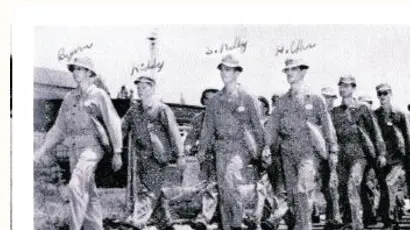
On February 21, 1942, a German U-boat torpedoed the tanker SS Republic just off the Hobe Sound public beach. Evelyn was six years old.
Dishes broke, and windows rattled as far north as Fort Pierce. Some residents were actually knocked out of bed by the shock waves of the Germans torpedoing our coral reef just offshore.
I was six years old, and my brother was eight. My parents told us we were going to the beach to help other people because there was trouble. I held onto my mother's skirt, saying, "No, no, no!" I could not understand why we were going to the trouble instead of away from it.
On Hobe Sound Beach, two lifeboats came ashore. From them men dripping oil were received into two exclusive residences. Mrs. Scranton, always the perfectly-coiffured lady, sat in a straight chair, wearing a pink satin robe, with an injured man's big dirty foot in her lap. She was picking glass out of his leg with tools from her Red Cross First Aid Kit.
From the book
The Big Freeze of 1895
On February 14, 1895, the freeze arrived on a northwest wind in full sunlight, with temperatures at twenty-eight degrees and dropping.
The citrus groves had been loaded with orange, grapefruit and lemon blossoms, and the pineapples were thriving. Tales were told of the citrus trees bursting in their centers, sounding like rifle shots. The owners had to cut the trees back to the ground to keep the rotting sap from killing the roots.
On the river millions of fish were frozen and lay on the surface of the water. Some of the solidly-frozen fish were gathered and shipped north, packed in ice. This was a sad situation, and many of the settlers were forced to live elsewhere.

From the book
The Jupiter Inlet Lighthouse
The lighthouse was lit in 1860 and could be seen twenty-four miles out to sea. This is the keeper's evening, every evening, for eighty years.
An hour before sundown the keeper and his assistants would go up into the tower, taking enough lard oil to last the big lamp throughout the night. Each evening the outside of the lantern and the glass prisms of the great lens were cleaned with Spanish white and spirits of wine and carefully wiped and polished. Then the clock mechanism that turned the lens was started and timed to a second so the flash varied by fixed lights would be in the exact time allotted to the Jupiter Lighthouse. While waiting for darkness, the men would go out onto the balcony for a breath of fresh air and a view of the breathtaking scenery spread out before them for many miles in all directions.
These are three passages from a book of hundreds. The rest is waiting for you.