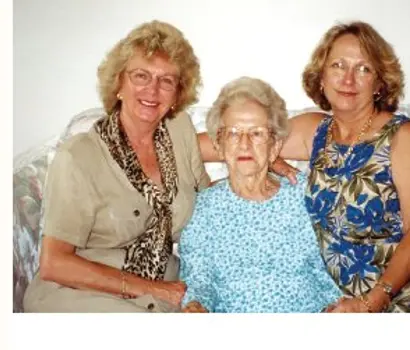
Evelyn McGee Way did not research Hobe Sound's history from the outside. Her family is part of it.
Her mother, Dorothy Powell McGee, was the first white child registered as born in Hobe Sound, on August 1, 1912, in a wood-frame house her father had built on Alternate A1A. Dorothy's parents, Fred and Grace Powell, had followed Henry Flagler's railroad down from North Carolina. Fred worked as an accountant for the railroad, and he and Grace were known around town for their cooking. They leased the Hobe Sound Inn in the 1920s, and people came for Fred's dessert-plate-sized lemon meringue and chocolate pies at twenty-five cents each.
Evelyn grew up in that Hobe Sound. She was six years old, holding her mother's skirt on the beach, the night a German torpedo lit up the water offshore. She climbed pine trees to find her way home when the path disappeared after a rain. She saved up fifty cents for a hamburger and a Coke at MacArthur's and ran there in the dark, because there were no streetlights.
She married Howard Way in 1955, and they raised four children (Michael, Deborah, Cheryl, and Linda) on Apollo Avenue. Over the years Evelyn worked a good portion of the jobs in the area: a stretch at Jonathan Dickinson State Park, five years with the Martin County Sheriff's Office supervising the school crossing guards and safety patrols, and a position as a Jupiter Island estate manager, where she worked for C. Douglas Dillon, the former Secretary of the Treasury. A great deal of this town's recent history, she did not have to look up. She was in it.


Why she wrote the book
Hobe Sound did not have its history written down in one place. The records that survived were scattered, and a great many did not survive at all, lost in the Seminole wars, lost in fires, lost in hurricanes. The people who remembered the early years were getting older.
So Evelyn spent thirteen years gathering it: the documents, the dates, the shipwreck accounts, the names, and the stories people told her. She worked to include the whole town, not just part of it. Her daughter Cheryl helped her research the churches and cemeteries whose records had burned, and they gave copies of that research back to the churches. Her editor, Faith Tofte, worked with her on every word.
What came out of those thirteen years is Hobe Sound from the Beginning, the first complete history of the town, written by someone who is part of it.
A note on the good-neighbor policy
There is a story in the book that says it all. After Howard passed, Evelyn mentioned to some friends that she wanted to get her yard sodded. The next thing she knew, a local crew and a whole group of friends showed up at her house with a potluck meal, a birthday cake, and a load of sod. They had the front yard done in less than three hours.
“This is old Hobe Sound,” Evelyn said.
That is the town this book is about, and it is the spirit the book was written in.